
We are using pre-filled syringes compounded by Trio Lab Inc. The syringes will come ready to use at the desired dosing levels i.e. 0.3, 0.5, 1, 2 and 3mg. These pre-filled syringes dispensed from vials that contain epinephrine 1 mg as the hydrochloride dissolved in isotonic sodium chloride solution with sulfites as an antioxidant and 0.5% chlorobutanol as a preservative. Nonmedicinal ingredients: chlorobutanol, hydrochloric acid, sodium bisulfite or metabisulfite and sodium chloride.
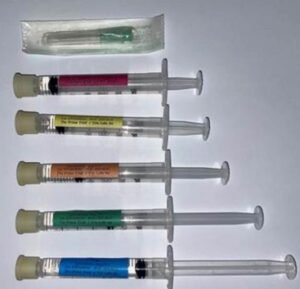
These syringes will be in a plastic sleeve labelled in accordance with the study specific pediatric measurement tape. Within the sleeve there will be 5 PFS and one IM needle. The PFS will be coloured based on the pediatric study tape, indicating the dose and the target participant weight range. The needle will be a 20Ga, 23mm needle and can be used in all study participants safely.
No. The study team will be providing your services with the required amount of prefilled needle/syringes at no cost to you.
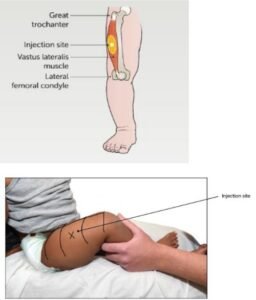
The IM injection should be administered to the vastus lateralis muscle in the outer thigh
(see images below).
In pharmacokinetic study in healthy human subjects, the IM peak drug concentration is equal to 1/10th the IV/IO peak drug concentration. The rat study (adult model) used 5x the IV dose of epinephrine and the piglet model (paediatric) used 10x the IV dose. The PRIME dosing is based on autoinjector (or needle/syringe) dose and will range from 3x (for a 60kg child receiving 3.0mg) to 10x (for a 3kg infant receiving 0.3mg) the IV dose, thus remaining within the animal studies safe ranges.
The used pre-filled syringes will be placed in a sharps container as you normally do for sharps. Expired and unused PFS will be returned to the research personnel at Children’s Hospital LHSC. Please have your local study champion contact the coordinator at 519-685-8500 x77548 or pager 18528.
Please document this in your ACR and inform your local study champion. The research team will follow up on this and inform necessary regulatory bodies
The risk of an inadvertent intra-osseus or periosteal penetration with the needle is negligible, according to a study performed in 300 children using similar sized needle in Emerade autoinjectors.
In the adult-sized adolescents, the risk of not penetrating the muscle (i.e., staying in the subcutaneous space) is low at about 10%, and is about 2% in children <30kg. If this occurs, it will result in a slower onset of action of the epinephrine.
No, this remains outside the scope of PCP practice. Once the IM epinephrine has been administered, you will continue per standard of care medical directive.
As an ACP, the study medical directive will ask that you administer IV/IO epinephrine– as soon as able after the IM injection and then follow with next doses every 3-5minutes as per the medical cardiac arrest directive. This is safe.
We ask that you complete the ACR as per usual high quality. The “Time of epinephrine dose(s)” (for IM and IV/IO) is particularly important for the PRIME Trial. We hope that if your service has CPR quality data available then this will be provided to the research team. We will collect all available information and assess for research purposes as needed.
Please inform your local study champion who will then reach out to the research coordinator at Children’s Hospital LHSC. This is Maysaa Assaf Maysaa.assaf@lhsc.on.ca 519-685-8500 x77548 pgr 18528.
Yes. If a patient could be under 18 years please follow the study protocol. It is essential that we don’t miss any children in cardiac arrest, because it is relatively rare. If the participant ends up being 19 years old, the research team will follow up as needed based on good clinical practice. This is safe for an adult too
A Paramedic Memo document, recorded study brief powerpoint session and a training video will be readily available through your local study champion. The SWORBHP website will also host all of this information that you can access at any time. You may contact the research team directly if you’d like a one on one refresher session, please contact Dr. Janice Tijssen or Maysaa Assaf (Janice.tijssen@lhsc.on.ca, Maysaa.assaf@lhsc.on.ca | 519-685-8500 x58386 or 77548 respectively) to set up a call and/or virtual/in person meeting. We will provide any additional resources and tools as deemed fitting and upon request.
As of October 2023, Ontario Ministry of Health website shows the following active trials happening:
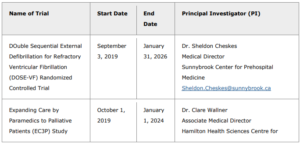
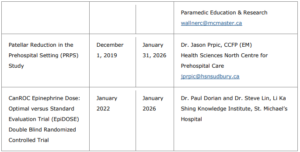
Of the listed, the DOSE VF and EpiDOSE are the only two cardiac arrest trials. Both are for adult (>=18) populations, so will have no impact on the PRIME Trial
No. Please continue with routine care and if possible, document reason for not using PFS and notify your local study champion. The local study champion will then inform research personnel.
No. You are not liable for any study related issues. The PRIME Trial study medical directive has been endorsed by the Ontario Base Hospital Group Medical Advisory Committee and approved by the Emergency Health Regulatory and Accountability Branch of the Ministry of Health. The Principal Investigator is responsible for all research conduct and the study directive allows for medical delegation of IM epinephrine for patients who are enrolled in the study. Paramedics must conform to all other BLS PCS and ALS PCS cardiac arrest care guidelines, regardless of the study taking place
Under these circumstances, please contact your Service leadership for available support as per standard practice within your service. The Principal Investigator will be willing to have a debrief session with you and your team to address any concerns or issues that may have come about during your call. We will be willing to work with your service to best address your concerns. The research team will appreciate all feedback and provide necessary corrective action to ease paramedic concerns throughout the duration of the trial. Our aim is to improve the process for paramedics attending the next potential recruit.
Yes. We will be able to randomize any new interested sites to the month block they’re coming in to. Please see table below. For instance, if Service A is choosing to take part in the study during Month 2, then they may be randomized anywhere between Block Sites 2-11.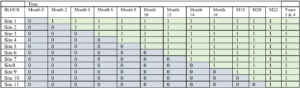
Your base hospital will need to contact the research team to ensure all documentation regarding ethics and agreements are in place before proceeding.
The research team will be connecting with the recruited families of both survivor and non-survivor patients. You will not be responsible in relaying any study related information to families. The research team mails out a letter informing families of the deferred consent process (Deferred consent – a process where participants are first enrolled in a study and then consent obtained after to continue in study) taken to recruit their child in the study. If they do ask while you are still on site, please direct any family questions or concerns to Dr. Janice Tijssen Janice.tijssen@lhsc.on.ca 519-685- 8500 x58386.
If the patient’s cardiac arrest is suspected to be due to anaphylaxis and they meet enrollment for the PRIME study, only the study dose of IM epinephrine should be given. This study dose of IM epinephrine will be sufficient to treat the anaphylaxis.
We are NOT excluding patients with cardiac arrest from drowning or hanging.
Yes, these patients comprise the majority of POHCA cases. All children who experience POHCA (including those with shockable and non-shockable rhythms) are to be included and given the intervention. We are only excluding those who experience POHCA directly due to trauma (e.g., motor vehicle collision).
Yes, please reuse the tape. We equip each pre-filled syringe package with one roll of study-specific tape. It can be reused for more than one patient and it should not be discarded after use. If the tape becomes soiled/torn and you require a new one, please let your study champion know, and email Maysaa.assaf@lhsc.on.ca so we can send you a new one.
Yes, we will replenish your stock prior to the expiry dates. We’ll send you an email with the tracking numbers, similarly, you’ll stock all ambulances with the new packages. When doing this, please be sure to retain the pediatric study tape and re-attach it to the new packages we send. Expired and unused syringe packages should be returned to research personnel at Children’s Hospital LHSC to the following address:
Attn Maysaa Assaf
Children’s Hospital LHSC
800 Commissioners Rd. E.
London ON
N6A 5W9
Ph: 519-685-8500 x77548
The research team will provide shipping labels upon request.
We will send you one or two extra packages with each delivery, so you can immediately restock the ambulances that administer the intervention.
Mechanical CPR devices are generally used for adults only, although some may be used on larger pediatric patients. If paramedics use the mechanical CPR device for a POHCA patient, they should document it as they normally would. We don’t anticipate that this will have any impact on the PRIME trial or the delivery of the intervention.
We don’t anticipate that SGA gastric suctioning will have any impact on the PRIME trial or the delivery of the intervention. If paramedics suction gastric contents through the SGA gastric port, as part of their airway management care, they should document it as they normally would.
The study medication will be supplied already drawn up in “pre-filled” syringes. Paramedics are NOT to draw up this medication from existing supplies of epinephrine that is carried. Each pre-filled syringe packages contains 5 syringes at the following epinephrine doses: 0.3 mg/ml, 0.5 mg/ml, 1 mg/ml, 2 mg/ml and 3 mg/ml. These syringes are to be administered IM ONLY.
Paramedics will determine the appropriate dose based on estimated weight of the patient (determined using the study-specific tape).
The ACR codes for the PRIME trial can be found under the ‘Research’ tab on the Ministry of Health ACR codes page. Here is the link to the page with the ACR codes:
https://www.ontario.ca/page/ambulance-call-report-codes
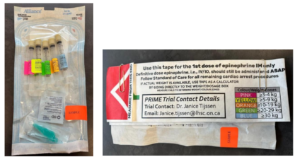
The study packages include 5 pre-filled syringes with coloured labels that correspond to the 5 different doses used in this study. The appropriate dose is determined based on estimated weight, which can be determined using the study-specific tape (also colour coded). The study package also includes an IM needle and alcohol swab.
The PRIME trial eligibility criteria does not exclude pediatric participants who may be prisoners or in police custody. Per protocol, paramedics recruit potential patients in a deferred manner, such that the research team further assesses and confirms the eligibility status of the participant and later informs participants of their enrollment in the trial. The Principal Investigator, Dr. Janice Tijssen, will review each case under this scope and confirm eligibility.